

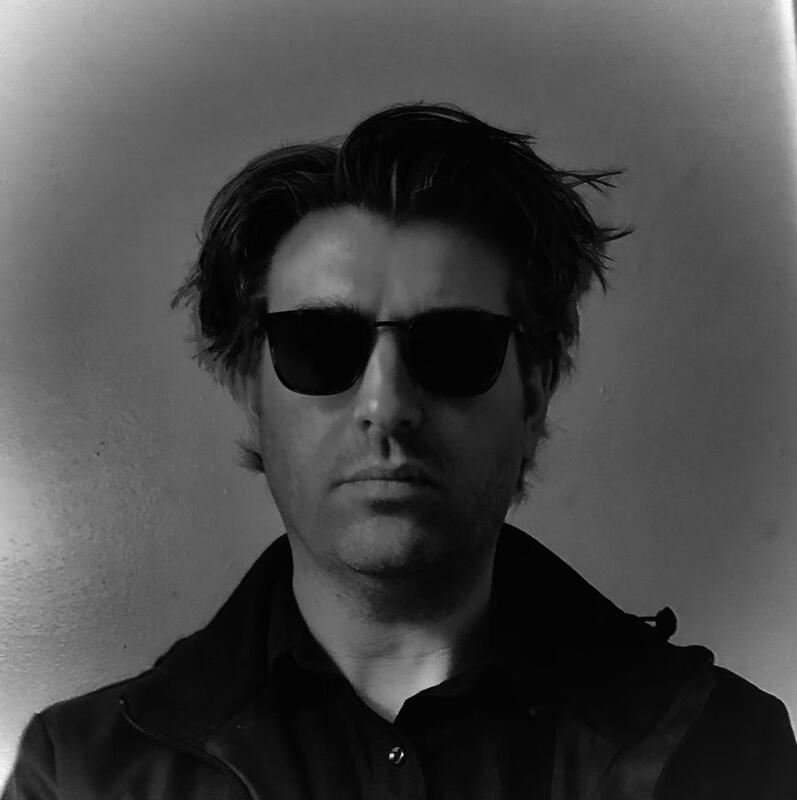
To have the honour of an intellectual friendship, means to be lucky to take feedback from people like Andrew C.Wenaus for many things, many times. This for me it’s a gift. His support for this difficult preparational period to build the publications side of Thrausma, his effort to advise, introduce and inspire, all makes one and only sense: we aren’t objective with his work. And we like this subjective approach.
His work is not for the client, consumer reader. What brings to us the Andrew C.Wenaus work is the constructivism of the imperceptible from the point of view of imperceptible, of untranslatable, of the Alien traces inside the framed topology of our phenomenology. In any case the stage is ready to host you to this fantastic dialogue, stay open, think the playfulness of this discussion as a reflection of unknown cosmic energies which are hosted ephemerally in our language.
Spyridon-Stefan Kogkas.
Andrew C. Wenaus is a writer, poet, painter,and literary theorist whose work orbits around the relations between poetry and mathematics, universal emancipation, and biocosmism.
He is the author of The Literature of Exclusion: Dada, Data, and the Threshold of Electronic Literature (Lexington, 2021) and Jeff Noon’s Vurt (Palgrave Macmillan, 2022). Recent creative pieces includeDeclaration of the Technical Word as Such (Sweat Drenched Press, 2023),Ω – 1 Chronotopologic Workings(Schism Press, 2023), Libretto Lunaversitol: Notes on a Glottogenetic Process (with Kenji Siratori, Calamari Archive, 2024), and Dead Code and Other Dramatic Entertainments (with Jeff Noon, Andrew Joron, Gary Barwin, Tom Prime, and D. Harlan Wilson).
He is the editor of the experimental writing anthology Official Report on the Intransitionalist Chronotopologies of Kenji Siratori: Appendix 8.2.3 (Time Released Sound, 2023). His critical writing has appeared in James Joyce Quarterly, Extrapolation, Science Fiction Studies,Paradoxa, Journal of the Fantastic in the Arts, Irish Journal of Gothic and Horror Studies,Foundation, English Studies in Canada, Foundation, The Journal of Popular Music Studies, Big Other, and Electronic Book Review.Forthcoming books include Didn’t I Tell You My Love? (with Rosaire Appel, Timglasset Editions), Zipf Maneuvers: On Non-Reprintable Materials (with Germán Sierra, introduction by Steven Shaviro), and a bilingual Greek-English of Incontrò / Trānstulī / Metempsúkhōsis (with Daniel Y. Harris).
Wenaus is also a composer and, with Christina Willatt, has written, recorded, and performed electro-acoustic scores for theatre, dance, film, and contemporary classical ensemble. He teaches at the University of Western Ontario.
S/From your critics to Jeff Noon’s multiverse to your last work ” Libretto Lunaversitol: Notes towards a Glottogenetic process” what is permanent to your thought is the pursuit to be released from the language and its communication establishment/dictatorship. Do you think that the Deconstruction project, initiated actually in the beginning of the 20th century, never completed its mission?
AW: This is a really good, and difficult, question to answer. First, I do not think that the deconstruction project, which likely demonstrated its most concrete appearance in the work of Tzara and Schwitters and the Dadaists, has completed its mission. However, I do not see this as a failure; instead, I do not think that it is a realizable project in a literal sense.

Where I turn to seek emancipation, and where the anglophone world needs to examine in more depth, is the work of Velimir Khlebnikov and Aleksei Kruchenykh. Unlike the European iconoclasts who sought to smash the control mechanisms of bourgeois language into smithereens, the Russian Cubo-Futurists were not so nihilistic. When we think of the deconstruction project in Europe and America, what we see is a discovery of a linguistic chamber. This chamber is prison-like; however, it was mistaken for the prison itself.
The aleatoric techniques from Italian Futurism, Dada, and Surrealism to the American and North African cutups of Gysin and Burroughs, to Derrida’s brilliant investigations all assert Kantianism: the noumenal is inaccessible. So, we reach the colloquial conclusion that if something is too abstract as to be accessible to our sensible intuition then “there is nothing outside the text” (to bastardize the phrase as everyone does).
While I do not claim that any of these thinkers or artists are strictly linguistic determinists (they’re too nuanced to make that claim), the ways this legacy has influenced a line of linguistic experimentation tends towards a destructive pessimism, on the one hand, and tragedy, on the other (though, I exonerate Derrida here).
Instead of destroying the linguistic mechanisms of control, limit, and oppression, the Russian Cubo-Futurists sought to expand the parameters of language by inaugurating a kind of hyper-fecund environment of linguistic evolution. Khlebnikov and Kruchenykh’s essay “Declaration of the Word as Such” is a good place to start: it is a provocative manifesto that asserts the emergence of various linguistic offspring from any given word: Khlebnikov’s “Invocation by Laughter” is just this: an incubation chamber for words to grow from the source word “laughter.”
They later go further by asserting that this same process is possible beginning from a single letter. I sometimes see a tendency in the destructive side of linguistic emancipation as that which has resigned itself to treating the current limits of language as absolute limits as such: thus, pessimism, tragedy, Lovecraftian pulp-psychosis, etc. I read, respect, and enjoy these writers, I appreciate their work and find it fascinating, but I’m operating in a different workshop.
While the deconstructive lineage seeks linguistic emancipation by breaking down the walls of the linguistic labyrinth and then building the hallways anew, I hope to be part of an investigatory trajectory that seeks to expand language into, not a, but the cosmos.
That is, break down the linguistic labyrinth including its outer walls, and then cart the ruins towards a foundation fit for new, unprecedented construction. So, my work, especially recently, turns to Khlebnikov more than anyone else for inspiration.

Or, if I may bring one of Khlebnikov’s collaborators into the mix, I seek to be part of those who are offering “black square” (à la Kazimir Malevich) equivalent to writing: to represent what “doesn’t exist” as given by current linguistic parameters and, in doing so, expand perception. Everything exists outside the text, so we need to begin creating a vital text that can evolve to best suit the conditions of reality rather than simply appealing to our condition.
How is it, for example, possible for the English language to have under 200 prepositions in light of scientific understandings of space, time, fractal dimensionality, theoretical physics, etc.? Every letter can, and should, spawn trillions of combinatorial possibilities to begin expressing better suited descriptors of reality.
If we do this, we will not mistake the Borgesian map for the territory; instead, we’ll build that communicative tower that will help us reach an understanding so we can think things as they are for the first time—we won’t be terrified nor will we go mad—we’ll simply see a glimpse through the eyes of Hölderlin’s gods whose eyes are forever in flower, “their blissful eyes / Eternally tranquil gaze, Eternally clear.”
Once we have created alanguage of infinite expressions, we can begin to create, as the 18th Century English materialist David Hartley imagined, an algebra of language where everything is as clear, everything is precise. So, I think Cthulhu as a metaphor for the extralinguistic or extrasensible works only so long as we identify as nervous, conservative protagonists.
No, rather than Cthulhu, I subscribe to the line in the early Christian era text Corpus Hermeticum: “understand the Light and become friends with it.” We need an infinite language, so that we can beginto articulate ourselvesand reality with algebraic linguistic elegance.
S/Beyond the usual classifications, what you are doing is a work that has a clear trace of Posthumanism but without restricted in the certain fetishism that unfortunately tends to categorise this movement to the aesthetics of a BDSM Philosophy for aliens.
Share with us more about the synthesis of Biocosmist and Post Kabbalistic dimensions of your experiments.
AW/I suppose its natural that any act of aesthetic formal transgression finds its natural expression via transgressivecontent.But, you’re correct, my work is not following in the lineage of Sade, Bataille, etc. That is, I’m not concerned with the cybernetic analogies of sexual transgression or, for that matter, pessimistic horror.
What I will say, however, is that I very much respect these authors: David Roden, Gary J. Shipley, Charlene Elsby, Kenji Siratori, and B.R. Yeager are all authors I’ve discovered in the near-ish past. I love their formal experimentalism, the philosophical sophistication, the absolute deterritorialization (of Siratori’s work in particular), the psychological nuance, and fascinatingly, and uncompromisingly complex protagonists in their work.

By disposition, however, I don’t tend towards the horror or transgressive side of Posthumanism. Instead, I like the conceptual expansionism of the posthuman: to shift the emphasis on the human as an epistemological source to that of the inhuman. We are indeed a “rational animal” and we’re capable of pretty much, at least I think, anything. But, I think its best to think of the human intellect not as set apart but as an extension of inhuman nature.
Life is at once, it seems to me, a thermodynamic necessity: life, on one level, exists to use and convert excess solar energy as a mechanistic necessity (very Bataillean, I know). And, yet, life is also matter and chemical procedures beginning to perceive itself through numerous magnitudes of material organization and evolution. I ascribe no pathos or intentionality to this. I think it is governed by necessary conditions and is mechanistic, autonomic.
There is likely no cosmic mind; but with the emergence of life, its possible that natural processes are willing their Creator into existence. Like amoeba, fungi, trees, birds, fish, and so on, humans offer an equivalent to a tiny synapse in the process of being born – our role, then, is to evolve an infinite language as an analogue to sense organs, and eventually an algebra of language as an analogue of mathematics (that is, a mathematical language that expresses all facets of reality, not just explain quantity of all kinds).
I suppose this is where my biocosmist posthumanism comes into play: I assert, strictly poetically, that the dead cold universe is, in fact, neither dead nor cold, but becoming immanently self-aware and, to borrow a word from the biocosmist anarchist Alexander Svyatogor, “ruddy.”
The Post Kabbalistic and Pythagorean dimensions of my work, then, rest on a fairly confident guess that reality is numerical or at least rests upon the necessary condition of the numerical, and that because number is infinite, in order to bring processes of conceptual emergence into existence, we should seek to create an algebra of, not number (we already have that), but language: a language that does not serve us, but helps us serve the expansion of the sense of and self-sensibility of the cosmos.

My book Ω – 1 Chronotopologic Workings (Schism Neuronics, 2022), for example, is over 700 pages of morse code-like glyphs. There is an elegant, rational design principle to the book and, if one looks closely, they’ll see that the morse code is, in fact, morse code-like, but not morse code.
I regularly get emails from readers of this book asking me about its translation. I always tell them that, like the Malevichian black squares that appear through the book, the language of Ω – 1 Chronotopologic Workings is the language of Ω – 1 Chronotopologic Workings and what it represents is something we still need to discover. What I will say, however, is that it should not represent anything that is already present to us.
I wanted to emphasize this on the level of the glyph. Libretto Lunaversitol: Notes on a Glottogenetic Process (Calamari Archive, 2024)does something similar, though its emphasis is on song and articulation. In either case, the books are grounded in that branch linking algebra and language, what I call patamathematical language or algebraic language,that I hope will flourish both in artistic laboratories as well as in scientific ones.
Again, at the core of my work is that of an expanding language but one where the monadic, totality of nature/universe/cosmos comes to colonize and transform the human more than the human will ever transform the cosmos. I suspect we’re simply part of a process of matter recognizing itself at various magnitudes, not unlike the variations of cells and chemicals and their attendant processes in a biological body. Who knows.
However, if one wants to take a look at some of the most fascinating and formally innovative posthuman poetry in the 21st century (that certainly does engage in Post Kabbalistic ontological level crossing) it is American poet Daniel Y. Harris’ work, particularly his ongoing The Posthuman Series.
S/Let’s speak about your ruins mix. How do you develop through fragments from canonical Art materials this nonlinguistic space for alien communication? What happens in your mind whenever you are in lab.

AW:First, I do very little work with sampling, quotation, or found material (though I admit that I’m fond of epigraphs). Most of what I write comes to me fully formed as an idea. It’s as if an idea bumps into me. I then spend weeks thinking about whether I’ll be able to achieve this or that…how will I pull it off, is it possible? I don’t know where the ideas come from – they tend to happen spontaneously when I’m out for a walk, sitting in a chair, reading, teaching a class, who knows.
One thing is that I don’t get ideas from dreams since I am a chronic insomniac and, at least through much of the last seven or eight years, rarely sleep deeply enough to dream. My figurative lab is one that, like a magical key or portal, appears spontaneously and it bumps into me or I bump into it by accident and borrow whatever idea it offers in the best way I can make sense – this is why I say the idea seems fully formed when I encounter it, but it takes time to determine whether or not I’m currently equipped to actualize it.
My literal lab is my writing desk, paper and pen, and laptop: once I’ve decided that I can indeed actualize something, I will get into it and become completely fixated and focused on achieving it that it can be very difficult to snap me out of my work. I’m sorry to say that I have little to offer in terms of my creative process. I stumble into ideas, I decide if and how I’ll realize that idea, and then I either work on it or forget it.
The ideas don’t feel like they belong to me. The ideas feel Platonic, though I know they aren’t, but I hope to intimate Platonic alien languages in my work rather than invasion-style alien languages. But, really, I don’t know where the ideas come from – when they come, when they stick, I strategize, and then proceed or abandon accordingly. That nobody understands these works—myself included—is a success: they aren’t meant to be understood or interpreted, but to provoke creative engagement.

S/I know its a cliche but would be interesting for many to know your top artists, creators or thinkers or whatever that gave signals to you following the Non linear creativity.
AW:In some ways I can answer this question simply by saying everyone and everything I’ve ever encountered has likely contributed to my interests with nonlinearity. But, this is difficult to say, who are my top artists. Certainly,and without doubt, most recently my inspiration comes from Khlebnikov. In Khlebnikov I have found a complete renewal of thinking.
Of course, there are major figures who are likely no surprise: Borges, Beckett, Joyce, Kruchenykh, Noon, Woolf, Tzara, Mansour, Breton, Eluard, Ernst, Carrington, Nalimov, Pessoa, Mandelstam, Burliuk, Federov, Hopkins, McLuhan, Tsukamoto, de Chardin, Bakhtin, Guattari, Jaap Blonk, Lyotard, Flusser, Meillassoux, Dickinson, Stapledon, Malevich, Lissitzky, (Douglas) Hofstadter, Tutuola, Gibson, Lynch, Jodorowsky, C.C. Hennix, and so on and on and on. I’m deeply inspired by music: Xenakis, Ligeti, Bach, Scriabin, Rachmaninoff, and so on but also Squarepusher, Autechre, Aphex Twin, and Flying Lotus.
Some contemporary artists, writers, and poets who inspire me are people I collaborate with: Andrew Joron, Gary Barwin, Tom Prime, Erin Gee, Jeff Noon, D. Harlan Wilson, Rosaire Appel, Kenji Siratori, Daniel Y. Harris, Germán Sierra, Marshall Stonefish and, though I haven’t collaborated with them, many more, like Louis Armand, Yeager, Roden, Shipley, Bogna Konior, Louis Armand, Christopher Dewdney, Christian Bök, Reza Negarestani, Amy Ireland, Zak Fergusson, and so on.
I simply can’t name everyone. It’d be impossible. My friends and students inspire me and point me to wards ideas; some of my colleagues do too. But today my main source of inspiration is Khlebnikov. When I’m burnt out and have no ideas, I watch Tarkovsky.
I don’t exactly know how, but I am certain that the MS-DOS game Stellar 7 played a role in my artistic development – I loved that game, and the fact that I played it with a 3-colour monitor (rather than the game’s full colour), gave me an appreciation for abstraction.
My most consistent source of inspiration is the composer and musician, my wife Christina Willatt, who I collaborate with in the music project Wormwood. I talk with her more than anyone else, and her skill and observations challenge me and help me develop more than anyone else.
S/What is more attractive mentally through this process of dehumanising communication forms? a kind of personal transformation, the madness to enter in mystical fields of materiality? Let us get in your mind more about it.

AW:Foremost, the asemic quality of some of my work (Libretto Lunaversitol and Ω – 1 Chronotopologic Workings, in particular) is meant to invoke everything from being astounded to frustration. It is written in International Phonetic Alphabet and expressed mathematically – it is Zaum poetry, that is, it is both a work of semiotic and syntactic exploration as much as it is a kind of writing that allows the sound to generate, as Marjorie Perloff writes, its “own range of signification” even to the degree where the process is meant to invent “new words purely on sound.”
The end goal, however, is that of seeking humility. From humility the future can grow – from a priori certainties resting on current communications, there’s inevitable failure. Instead, humility—the humilis or grounded or lowly—is not Earth-bound, but suggest Earthly fecundity. Humilis, after all, finds its etymological lineage in humus: earth.
The humility I seek with these alien languages or asemic typographic glyphs is that of planting and cultivating new parameters of language and communication. It is a humility that asks us to accept that we know very little, that this should be a source of vitality and strength.
In the introduction to Bifo’s recent book, Quit Everything: Interpreting Depression, he writes that “we are helplessly witnessing the private appropriation of public goods, the destruction of the social achievements of the past century, and the devastation of the environment. Now we should thoroughly accept impotence and turn it into an invincible weapon.”
What I mean by seeking humility is to seek the germination of new languages in both the humilis of one’s sense of certainty and humus of the planet: that we need to plant the seeds of universal communication, to communicate in such a way as we can create a planetary apparatus of communication, to emancipate from former linguistic systems of control through generative synthesis without eradicating the wealth of languages, an algebra of communication that grows from both the humility of the individual and the planet. In doing so, yes, I think the goal is a kind of, not personal transformation, but species transformation.
Planting the seed of a new universal language of emancipation, having—I’m hesitant to use the word “mystical”—communion with the zero-point of language and its conceptual and material foundations, accepting that the project will be slow and frustrating but remembering that it is our duty to guarantee that the future be impeccable. We can only do this through humility.
We dream of the hanging gardens of Babylon, but when we open all we see is the desert of the real resulting from the confusion of languages. We dream of these hanging gardens, but we need to create—not discover, you can’t discover from these stories and myths, so why not consider myths as blueprints, not proto-historiographies—”the hanging gardens of Babylon”and its antecedent tower will grow from our cultivated universal algebraic language – seek a unifying flattened or planar metaphor and the temporal apparatuses upon which its logic rests.
I only speak in metaphor, of course. But, we if keep at this project, we can begin to bridge the gap between vehicle and tenor, between signifier and referent: there will be no arbitrariness to the universal language and all interpretants will begin to think a more accurate relation to the world: they will be able to make choices in the absence of linguistic ambiguity. Of course this is absurd. Of course everything is absurd.
Our duty, then, is to commit to creating a reality that is not absurd. The unreadability of some of my work, then, is to provoke illiteracy, to welcome humility, and to say that we must begin to plant new languages, to grow a universally emancipatory linguistic garden across the planet, and then allow our garden to grow and grow and hang from the sphere of the planet, to allow our vines to climb beyond the upper canopy of trees, and to float and waver like informatic kelp into the cosmos.
But it begins by admitting defeat, accepting our lowness, and seeking new tactics at the zero-point of communication: we must turn impotence into an invincible weapon. The point is not to interpret the world, nor to change it; it is to create the algebraic word according to what the world’s steadfastness demands: “Nothing,” as Robbe-Grillet writes, “is more fantastic, ultimately, than precision.”
S/Do you consider that the reason for the reproduction of the Language barriers and its forms of meaning domination is the existence of the social organisation? I mean can we work to create open social intelligence worlds without be systems, without be organisations of meanings?
AW:Maurice Blanchot asserts that “the truest way to the deepest regions of another’s soul is…the written word”; if this is true, then we’d better make sure that the words and their glyphs are precise. Otherwise, you’ve simply discovered the deepest regions of one’s own understanding of another’s soul: which is to say, you’ll be incorrect. I think that there must be systems and that meanings must have organization.
That is, systems—or aggregates of nested procedures—must add up to a structure. If they do not, we have massive confusion. The structure that is being sought is that of a universal emancipatory language, its nested procedures will be the long-term experiment of linguistic expansion: the creation of words, glyphs, sounds for every possible object, concept, and relation possible to the point of infinity.
From here we now have, like number, the infinite grounds for building an algebraic language. However, before we do this, we do need to emancipate ourselves from the languages we are currently using—we do not need to abandon or destroy our beautiful, though infinitely limited, languages; instead, we need to synthesize and expand.
This cannot be achieved in a lifetime or in thousands of lifetimes. It is likely unachievable by humans, but art’s objective must always be impossible to achieve if one is to realize anything beyond self-back-patting confirmation.In the presence of a trulyinfinite semiotics, we experience both anxiety and elation; yet, we can use these infinite conceptual resources as linguistic seeds, as Khlebnikovian words-as-such.
S/Is not music enough for you to resume the absolute abstract power of non hierarchical meanings and humanised narratives? Why this game with the writing and symbols destruction and their reuse is still necessary?
AW:Music, for me, is not enough, butbecause it also emerges from the same node as language, it will be an essential component in the discovery of an universal emancipatory language. But music, speech, and written language—no matter how complex, beautiful, divine, impeccable they appear to us—are, ultimately, in their embryonic species-boundedness.
Just as our current languages are human-bound and planet-bound, music is only perceived as such by those who would share similar neurology and physiology to humans (whether as performers of music or listeners).
Nevertheless, music plays a fairly important role in my creative process – Official Report on the Instransitionalist Chronotopologies of Kenji Siratori, a collaborative work I oversaw, is accompanied by an hour-long composition by Christina Willatt and myself (under the moniker Wormwood).
Libretto Lunaversitol goes even further by not simply having soundtrack but being written in International Phonetic Alphabet: the musicality or sound of, not only the soundtrack, but the work itself offers two different strata through which to glance our limitations at universal communication. Libretto Lunaversitol is, in many ways, as much a book of Zaum poetry as it is graphic notation, a visual musical score.
When it comes to the play of symbols, the alternative semiotics and linguistic practices of occultism and other religious systems, for example, rely on the sigil or icon as composite glyphs that can shape and determine reality itself. This is, of course, a conceit and a challenge and not to be taken literally in the present. The problem in so much Western occult semiotics is that the practice seeks the original Word – that reality was impeccable, and is now postlapsarian.
There is an active and urgent sense to this work typically done by Medieval physicians, mathematicians, clerics, and scholars who were working clandestinely to put the world back into its original order.
The problem, however, is that they mistake religious mythos as a kind of historiography rather than considering it as blueprints: they are looking for the answers in the past, while ignoring the possibility that the divine Word, the Logos, the impeccable, precise algebraic utterance is something that must be actively created, incubated, fostered, and cultivated.
My experiment considerers that the pieces were never total or whole; the fragmentation is not the result of some kind of past catastrophe or transgression (limited by historical Abrahamic bias), but that fragmentation is simply what is given, a necessary condition for the generation of a precise articulation of this aleatoric, unpredictable configuration.
The goal is to create the divine Word, to create an emancipatory language, that does not bring order to what is given, but instead is able to precisely articulate that which seems unbearable simply because we are currently ill equipped to describe it.
That is, a universally emancipatory, algebraic language will not bend the cosmos to our will—that’s absolutely absurd—instead, it will pronounce a monadic totality with precision. There is nothing to be repaired about reality: we are simply ill-equipped to understand the material processes and objects outside phenomenal experience, so we blame reality rather than accepting humility. Again, my work is an exercise in or rehearsal of humility.
S/What kind of Dadaism can we discover in Datalands and how can we deeply turn ourselves to be fragments of these infinite cataclysm of meaning disasters?
AW:There’s this phrase from Catherine Christer Hennix that strikes me as relevant here: “the eternal presence being constantly controlled or determined by what is eternally absent.” What Dada and Data have in common is that they signify “no thing,” they draw attention to the necessary condition of a presence eternally absent from our modes of communication.
Data, as information, is asemic: it is not meaningful according to our attitudes towards meaning as Shannon and Weaver pointed out last century. Dada, too, signifies “no thing,” but unlike information/informatic data, Dada is an intentioned protest.
The Dadaists, I think its fair to say, were not simply saying that Dada is pure nihilism—it can also be said that Dada signifies those things which have escaped articulation: the no things according to current linguistic and semiotic apparatuses.
Both Data and Dada are, in their own ways, affronts to conventional modes of meaning; but they do not have to always be considered catastrophic; instead, they are instructive in that they reveal the limitsof communication for ustherefore revealing that we need to collectively work towardsprecise communication as such. The infinite cataclysm of meaning and the disaster that we often encounter in communication is simply the result of our disastrous system, not of a necessary condition of, to borrow Meillasoux’s term, the “great outdoors.”
So, I am not a pessimist in the sense that I do not think of reality as hostile, I do not think the universe is crying out in pain, and while I find entertainment and fascination in these horror and science fiction metaphors, I am more inclined to think of reality as asemic and indifferent according to our current relation to it.
That is, reality is likely no more hostile or suffering than it is hospitable and creative. So, as a way of shifting so much emphasis away from the purely negative, I hope to offer some experiments that may suggest the opposite: reality is infinitely creative and is a reorganizing, emergent, inhuman, totality. I’m going to go with Berdyaev’s denaturalizing of “Love,” rather than catastrophe, destruction, and despair, as the guiding principle of that which rests beyond phenomenological access.
“In Love,” Berdyaev remarks, “there is something aristocratic and creative, something profoundly individual, unracial, something neither canonical nor normative…Love lies in another plane of being than that in which the human race lives and orders its existence. Love lies outside the human race and passes beyond the consciousness of the human race.
Love is not necessary to the race, to the perspective of its continuation and ordering. It remains, as it were, at one side…Love will submit to no setting in order…we cannot theorize about love, nor moralize, nor sociologize, nor even biologize—it is a foreign flower, perishing in the midst of this world. The growth of love is a tragic impossibility. To this all the great poets and writers of all ages bear witness.” A universal language of emancipation seeks to merge with and as Love – that’s our project.
S/Can we say that your works are an open invitation to the unknown becoming of Alien Intelligence to expand its semiotics in every corner of today’s culture? / A kind of education on ephemeral set of codes and passwords for us, in order to be part of this cosmic conspiracy?
AW:Yes, absolutely. Though, perhaps rather than education, it is experimentation—attempts, proxies, essays, failures, rehearsals but genuine effort nonetheless. The cosmic conspiracy, in my thinking, is less that of secret plans or deceitful designs, and instead, that which seeks to breath together (con- “together,” spirare “to breath”).
Its misleading to say that we need to breath with the cosmos simply because our languages are ill-equipped; instead, to be “part of this cosmic conspiracy,” means to bridge the gaps between signifier and referent through precise, emancipatory, algebraic language: the “air” we all inevitably “breath” is both inside and outside.
S/Whats next? What are you thinking to creatively move forward?
AW:Good question. Practically speaking, I have a few projects on the go: a conceptual academic protest book called Zipf Maneuvers: On Non-Reprintable Materials co-authored with Germán Sierra and with an introduction by Steven Shaviro (forthcoming from Erratum Academic Division). I also have a finished collaborative piece with Rosaire Appel called Didn’t I Tell You My Love? that should be publishing sometime in the next year or two. I am also working on a series of visual poetry pieces with the Canadian poet Claudia Kindrachuck.
Daniel Y. Harris and I will likely continue our collaborative work for some time into the years ahead – at this time we have a chapter/manifesto titled “Connecting and Disconnecting King Alfonso Xi’s Automaton: On Poetheory, Interdiegeticism, and Neurototalitarian Refusal” that’ll appear in a bilingual Portuguese-English collection and a short book titled Incontrò / Trānstulī / Metempsúkhōsis that is also forthcoming.
There are a number of experimental, comic theatre pieces that I need to complete. My biggest project, however, is a book of patamathematical poetry where I investigate algebraic language – this will take a few more years to complete, I imagine. As for the future? At this time, rather than moving forward, I hope to be wherever I am and hope that an Idea worthy of others finds me, bumps into me.


