

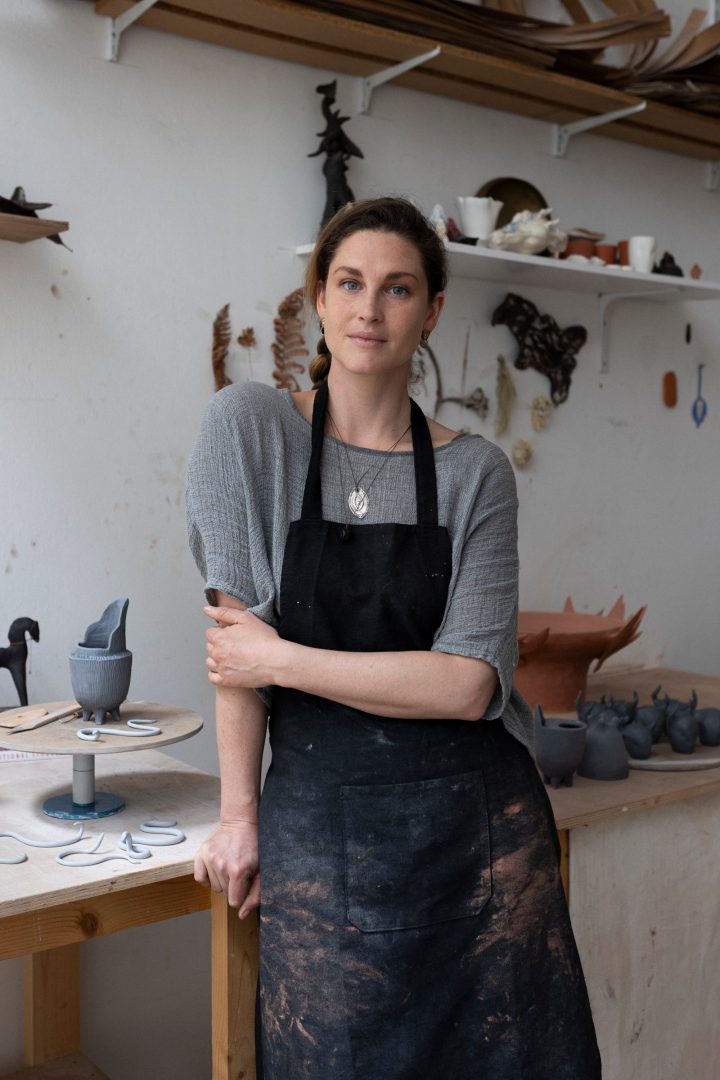
Personally, I feel lucky, not as a lead editor but as an artist myself, to be able to be the recipient of thoughts that come from a world magically free, indeterminate and creative so directly, so authentically unprocessed. This is the artistic and spiritual world of Diane Alexandre, asymmetrical because it does not exist in forms and ethereal because it converses beyond the intellectual prison of language. In this interview, she answers me exactly as she creates her works and this unique feeling will surely permeate the reader of this dialogue.
Diane, thank you very much again!
Spyridon-Stefan Kogkas, Thrausma co-founder & lead editor
Can you share a bit about your background? What first drew you to the world of art, and how did your journey as a sculptor, illustrator, and graphic designer begin? Does your experience in Fashion Branding connected or still assisting your artistic work?
I remember being quite a young child and already knowing which art school I wanted to enter. My only moments of peace and contentment were in my room, at my desk or on the floor, drawing in silence, humming my own little songs. My mother would take my creative endeavors quite seriously and would not ask me to complete chores when finding me drawing or painting.
I think I started drawing to tell myself stories, waiting for my sisters to be born, it was my first form of « play ». I would try to depict animals I wanted to pet or talk to, or landscapes I would love to nap in. The world of art and the world of Nature were deeply intertwined to me and very much contemplative and silent. My experience in brand identity design is still helpful sometimes yes, but it moved in the background of my mind now.
Who were your biggest influences growing up, and how did they shape your artistic vision?
My big influence was my grand-father Marc. His hair was mother of pearl white, he smelled like Lavender Yardley and he walked very slowly to my little legged pace. He always walked with his hands in his pilot bomber jacket but when he walked with me, he would leave one hand out, so I could grasp it if I would choose to. He always gave me the space and freedom I needed.

He was very much like an old wise cat. He read to me many books, amongst them « Le Petit Prince » and « Vol de Nuit », two beautiful novels from Saint-Exupéry, shaped a lot of my persona. Loyalty, friendship, adventure, poetry, animal kingdom, all those values are still mine today. My artistic vision is not so a vision than a silent prayer. I put my heart at someone’s feet like the cat drops a bird at your doorstep.
To create is to gift. I gift myself the time, the choice of not doing anything else. I gift someone (real or imagined) a feeling, a thought, a longing, a wish. My grand-father was a bit of a wizard in that he believed in the power of incantation. To repeat a ritual and to direct an intention is something I learned very early with him. As good pantheists, we would name trees and rocks and rivers. I still name my clay creatures and I infuse in them a part of my soul, as my grand-father use to infuse his songs and stories with a part of his.
Your work spans various mediums, from sculpture to illustration and graphic design. How do you approach the creative process across these different forms of art?
I don’t really differentiate to be honest. The first step is to be inspired. If I am inspired by words, I will most probably start by illustrate them with a 2D drawing. Drawing allows me to sum up a narrative, whereas clay work is more frozen in time or in space, producing one unit (a moment or a character belonging to a broader story). An organic shape or element that I pick up from the ground will definitely end up in a 3D object.
But most of the time, my creative process is determined or chosen to marry a very specific project. If I have carte blanche to create a large in situ sculpture or if I am commissioned a big number of small pieces, my brain will work differently. Since I come from design and communication, my stakes are not only aesthetic, they are also user or purpose oriented sometimes. But if I had to create a step by step generic process it would go like this :
1st a vague idea inspired by anything. (a poem, a myth, a painting, an object)
2nd a series of little rapid sketches to grasp quickly what could work and what would never.
3rd a more elaborate drawing to determine what medium would be the best.

Can you walk us through your typical workflow for a project? Do you start with a clear vision, or do you let the process guide you? What happens in your mind while you are creating?
I never have a clear vision. About anything in my life. My brain is like a pond with swirling opaque muddy waters. My feelings or ideas are like shiny fish scales I can have a fleeting glimpse of, when and if they decide to surface. I don’t have an inner monolog either. I don’t form complete sentences in my mind. Only when I write. I am an articulate speaker of course, because I trained to be, during a series of long and thorough studies.
But my nature is silent and foggy. Subjects are intuitional and have to gestate a long time before being born out of my hands. They are like longtime memories or long wished dreams. Unclear and uncertain. Always more desirable when not reached. My ideas are like the fox or the deer. I learnt not to chase them too violently. I know that the more I want them to feel precise, the more they will escape me.
Like shy nymphs. So I remember my grand-father’s hand. And I pause and let them come to me instead. If I stop and listen to the own music of my body, the pace of my breathing, they will come closer.
What role does experimentation play in your work? Are there any techniques or materials you’re currently exploring?

To be honest I would like to experiment more and more often. But experimentation is the artist luxury. It requires time and comfort to dwell into try outs that may not feed us. I am always experimenting in a way because I am self taught when it comes to clay and ceramic and so my technical success are as much a bet as they are a prowess.
Now I am thinking more and more of including other materials to my clay. Rocks, corals, but also bronze. I am also drawing a collection of design furniture. Which I am not yet sure of realizing in clay. So I am heading towards a vital moment of experiment.
Many of your sculptures and illustrations carry a strong sense of narrative, a personal mythopoetics and emotion. What are the central themes or messages you hope to convey through your work?
That love is possible. I don’t know any other thing I wish to say.
How do you balance aesthetics with the conceptual depth of your pieces? Do you prioritize one over the other?
I am not conscious of having to balance at the moment I am making. It’s always a bit too late than I think « this is too pretty » or « this is too mute » or « this is too self explanatory ». And so I start again.
Are there any recurring symbols or motifs in your art? If so, what significance do they hold for you?

I have been working around different animal / mythological figures. The owl was the first one, when I was I need of wisdom. Then came the horse, when I was in need of loyalty. Then came the Minotaur, when I felt entrapped in my own psyche. And finally the Kerylos, when I needed to fly free. Today I am starting to break free of my archetypes and to let myself create without a narrative. The last two pieces I presented at Art Athina emerged from unknown depths. I still don’t really understand them. But I trust it is where I need to go now.
Is this connection with Greece a kind of return to archetypical sources for you? A permanent symbiosis with something primordial under the postmodern fragmentality of today’s life?
It is my own form of psychotherapy. After all, myths are here to explain one to oneself. I am not really interested in today society. I feel everything that matters is inside. Except for the sea, the sky, the earth and life, evidently. I don’t even know what you mean by « post-modern fragmentality »… And I am not even sure I wish to know more about it. I found myself to talk less and even to express less ideas to myself.
I go deeper into the ideas I am interested in, and they are not even ideas, but feelings of ideals. I guess I am more and more behaving like my dog or my cat. They don’t express big ideas, but they live according to the feelings they have and those they want me to have towards them.
Your work often seems to draw from a mix of traditional and contemporary influences. How do you integrate these inspirations into a cohesive artistic style?

I guess you are referencing to the « Cycladic » or « antic » aesthetics of some of my pieces for the traditional side. And the contemporary would maybe come from my lack of « traditional technics ». I am not sure I reflect on this before I start. I shape what I shape and usually I imagine touching them before they exist. I roll my hands together and I ask myself how big or small, how soft or harsh.
I found that if I sketch too much, I will come up with lines that are more pure or « designed » than when I start directly with the clay. Then the result is more organic and « awkward » which I love. I think what I try to do is to get away from the « traditional technics » for I don’t like repeating myself, while remaining in the realm of the ancient and archetypal.
I notice your general interest on mythology+ Surrealism, mystagogic, erotic and subconscious dimensions. Can you share some of your sources of inspiration?

The Odyssea was the first book ever read to me at bedtime. The Greek pantheon of gods and goddesses fascinated me and opened to door to Egyptian mythology (and its long corridors on the ground floor of the Louvre museum I used to roam). I was obsessed with any animal or insect representation. I started collecting scarab amulets, little vials with engraved horns, a myriad of symbolic objects or images that would resonate with me. I use to identify with Circe or other sorceress figures, like La Loba, and collect bones, and woods and shells and dead things.
I still do… I think we all inherit archetypes and deities, even if they are not taught to us, they are living inside our ancestral source code. I have shaped 2 heads totems long before I learned about Kültepe, or drawn eyes on bodies without knowing yet about the Eye votives of Tell Brad. I think these primordial shapes have deep meanings that belong now to a cognitive commun « mare nostrum » and that art or self expression is simply one’s own navigation of this conceptual sea.

Are there specific artists, movements, or even non-artistic influences (like literature or music) that have significantly impacted your work?
For me, art is a powerful way to feel connected to other human beings and be part of a grater whole. Some periods trigger this feeling more than others for me. Everything that has been made in the Stone Age with simple tools is mind blowing. I went to the Benaki exhibition on Paleolithic tools a few month ago and I cried, looking at a Silex that had been carved to exhibit in its perfect center the fossil of a little seashell.
In this very far away everyday tool, I could still grasp without a doubt the personality of the one who once hold it. And at that moment we were one. I remember the power of Lascaux cave paintings. The movement of those aurochs, which did not yet belong to any school or academy. The very freedom they convey. They remind me of what Klimt or Schiele have achieved through their nude sketches. Utter freedom. That is what I like in surrealist poets like Paul Eluard or Boris Vian.
When you don’t so feel the scaffoldings around the work. When all seems to be held by magic, summoned on the page, erected out of an incantion rather than by technic. That is why Camille Claudel will always move me to tears, as well as Louise Bourgeois. Or Turner even. They make me feel instead of understand. They make me see beyond the surface or materiality of their work.

How do cultural and philosophical themes influence your creations? Are there any current issues that resonate with your artistic practice?
I am very much aware that sanctity is not within my reach and that I need to narrow down the list of my political and societal concerns to be able to have a real impact. And so my efforts are directed toward 2 targets in great need : women (rights, health, empowerment, education, safety, etc) and animals. I try to keep these two crucial groups in mind throughout my practice and more generally my everyday life. I found out that those two groups are at the crossroad of many other issues. If you say « war », « refugees » or « forest fire » or « recycling » you always say « women and animals ».
Working across multiple disciplines, what challenges do you face in balancing the different aspects of your artistic identity?
The challenge is to remain myself while creating. And to be identified as myself through my various pieces.
Can you share a specific project that was particularly challenging for you? How did you overcome those challenges?
1 year ago, I was commissioned a large scale piece by Manna, a five stars hotel in Arcadia. I chose to present the sketches of a two meters high totem representing the myth of Arcas and Callisto. I had never worked on such a big scale before. That was the first challenge : to go from twenty centimeters high to two meters high. All my body had to learn how to move around those pieces.

Then I chose to combine different clays, different temperature and glazing technics, doubling or tripling my tests phase. Then I realized that between my drawings and my 3D objects there was many differences that changed the final result, it’s balance, the number of pieces to combine, etc.
Out of ten elements I chose to combine only four. What I learnt from this long summer is not to touch the clay if I don’t feel ready. As frustrating as it feels for someone like me who is guilt-tripping myself over the stupid notion of productivity, the lesson is to walk away.
How has your artistic style evolved over the years? Are there any pivotal moments that marked a shift in your approach?
I am the last person to be asked that question. I cannot be the artist and the critic all in one. What I can say is I don’t like the word style. I don’t understand it.

As a graphic designer, you’re familiar with digital tools. How do you see the relationship between traditional and digital art forms? Do you think technology has changed the way we perceive art?
I think a tool is a tool. The only problem with artificial intelligent tools is that they leave less and less to us. That is why I don’t use them. I don’t ask Chat GPT to answer your questions for me. I don’t care if my language is not appropriate, at least it’s not formatted. AI formats, it generates new standards, that may appear to be new, but they are just standards in the end.

Of course I use InDesign if I want to layout a book, or a catalog, I use Photoshop if I need to edit some pictures of my work, I will use Illustrator if I need to create a stamp for a brand I will work with, or Procreate to draw mock-ups of my designs to submit a creative proposal.
They are my tools to express my ideas. But they are not automated. They respond only to my skills. I would have written the words in my book, I would have taken the pictures of my work, I would have designed my own logotype and drawn my own mock-ups. Without using 14 litters of drinkable water per hour.
How do you navigate the boundaries between craftsmanship and digital techniques in your own work?
Digital is not the antithesis of analog for me. I am using my computer to answer this interview. I could send you a letter by the mail. It would make it considerably annoying for you to not being able to « copy-paste ». But that’s about it. Some digital tools make my work faster or easier. If they don’t, I don’t use them.
In an age where art is increasingly shared and consumed online, how do you feel about the digitalization of art? Does it affect how you create or share your work?

I like being able to take a picture of my new piece, to edit it the best way I can, for the light to touch it in the most beautiful way, and then to share it on my Instagram profile, and to write a caption that will inform my followers a bit more about the subject of the piece, the materials, the technics involved.
Social media is for me a platform (not so much for selling) to relate, to communicate, to share. It does not stop my piece from existing in the real world. It enables it to travel a bit further and faster than before. What I cannot really relate to is the concept of NFTs for example. But a NFT or Cattelan’s banana are the same to me. They hold no intrinsic value. They have no soul. One is digital, one is physical.

How do you feel when people interpret your work in ways you didn’t intend? Is the viewer’s interpretation as important as the artist’s original vision?
I am thrilled. I am always very grateful when people take the time to tell me about my work. What they see, feel, comprehend, refer to is always so rich and vivid. It’s a true gift.
Have there been any memorable reactions to your work that stood out to you, whether positive or critical?
I remember when I exhibited alongside Theodore Psychoyos in Los Angeles. We were showing at Boite Noire Gallery a long Mytho Erotics fresco, large scale and smaller drawings. One of them was called Amour et Psyché, and figured a couple making love, underneath a greek village, and a large 2 tailed barking dog spitting bubbles of guts and other organs.
A group of 6 native Americans came in and they were curious to know if we had been introduced to one of their founding myths, involving such a dog. As my answer was « no », they exclaimed that we must have been touched in dreams by this dog god and thus we were welcome to their land. They left very happy and I felt elected.

What do you hope people take away from experiencing your art? Is there a particular emotional response or thought you aim to evoke?
I do not hope no. I don’t even hope for a response. What I do I do for myself. I share it, but it remains mine.
Are there any upcoming projects or exhibitions you are particularly excited about? What can we look forward to seeing from you in the near future?
I cannot say, I am highly superstitious and I would hate jinxing it. But you can wish me a triple yes on a collaboration with a big luxury brand, a big hotel, and a big gallery.

Looking ahead, are there any new mediums or techniques you’d like to explore?
I am thinking more and more of furniture design.
How do you envision the future of your artistic practice? Are there any long-term goals or dream projects you aspire to achieve?
I am looking for a gallery / agent representation. That is my next chapter. To feel trusted and encouraged and chosen. To have somebody saying at loud : « I believe in your work ».
What advice would you give to young or emerging artists who are looking to establish themselves across multiple artistic disciplines?
Just produce. Don’t restrain yourself with nothing like public, audience, trend. Just do. Out of the sea of crap you will swim in, a golden raft will appear.
What are some of the most valuable lessons you’ve learned throughout your career as an artist?
1) Never say « I don’t how to do that » when offered a job / project. Always say yes and learn on the spot.
2) You have the right to change your mind. If you come back the next day and see your work and decide it can be better, change it. Don’t stick with an idea for the sake of it. Don’t be stubborn. Change. It’s ok.
3) Walk away. Don’t ruin your mood, your material and your time. Go for a walk.
In your view, what is the role of art in today’s society? How can artists contribute to meaningful cultural or social change?
I was always concerned as an artist I was not contributing to society. Looking at my younger sister (criminal lawyer, saving the world everyday), I often would tell her how embarrassed and ashamed I would feel next to her. But she told me « At the end of the day, when I indeed saved the world or failed to do so, when I witnessed all that is vile and low in human nature, when my hope is gone, when my ideals are weakening, I look at your work and the world finds beauty again. And I can carry on. » That is why I believe in my place in today’s society. There may be other reasons but this one is mine.
Do you believe that art should challenge the viewer, provoke thought, or simply exist for beauty’s sake? Where do you see your work fitting within this spectrum?
I don’t think I am challenging politically, I can maybe impulse in my viewer a desire to dig deeper in themselves. To feel whatever there is to feel. I don’t mean to choc or provoke. I don’t mean to be only decorative either. I see my work like I see my inner pond, fleeting and opaque and beautiful.

Diane Alexandre is a French born graphic designer, living in between Paris and Athens.
After a two-year degree in modern litterature, she studied graphic design and art history at l’École Nationale Supérieure des Arts Décoratifs in Paris, then graduated from a Master degree in Communication at Sciences Po Paris. Over the past ten years, she has worked for prestigious design and advertising agencies, such as H5, Publicis Royalties or Posternak & Margerit, Obo Global, Hub Id, Auditoire.
Specializied in luxury, she counts among her customers Facebook, Shiseido, L’Oréal, Yiqing Yin, and Pierre Katz, French brand identity designer with whom she collaborated for Hermès, Ruinart, Lejay, and others. Passionate about music, she also has been overseeing the artistic direction of the French Touch electronic music label Missive, during twelve years. Diane has always been working on several creative fields, from print to web design, from storyboarding to directing video clips, from photography to drawing.
From 2016 to 2020, she has been collaborating with artist Theodore Psychoyos. Together they formed Diane & Théodore and have been exhibiting the MythoErotics project, a drawing study on love through the prism of erotism and mythology. Their exhibition has toured in NYC, L.A., then Paris and are presented in Aphilo Athens.

For the past five years, Diane has been developing her sculptural work, in clay and porcelain, marking a point on her ongoing journey, started at a very young age at the feet of a grandfather storyteller, in search of meaning and inspiration in myths and mythological symbolism. As a child, she felt an early connection to what adults would call “inanimate objects”. Trees, rocks, plants exuded a vibration she could feel. She started her pagan conversation in silence, without dissociating animal, vegetal and mineral from human. “Everything seemed to me like held together by a same emotion”.
Her work is shown in Athens at the Athens Cycladic Museum‘s boutique, Aphilo, Mon Coin Studio, Ioanna Liberta jewelry store, Heroes, as well as in Taxidi Tinos, More Than This and Act As If in Antiparos, Casa Alma in Paros. Some of her pieces can also be seen in Zacharitza 27, the new design home created by Molonglo, for which she has been curating artworks and selecting furniture, along with Théodore Psychoyos.
Her last large commission can be seen at Manna, a five star hotel in the region of Arcadia.
Fields of expertise :
Semiotic, semantic and cultural analysis / brand strategy / art direction / signs, symbols and types design / brand graphic charting / packaging / edition / illustration / story boarding / sound design / sculpture/ ceramics.


