

By Spyridon St. Kogkas
In the second part of his under process essay on Gantz of Hiroya Oku, Spyridon St. Kogkas focusing on a model of “Situationist semiological guerilla” and how it reflects posthuman autonomy in the age of technological de-humanisation , exploring several layers of meaning embedded in Hiroya Oku’s work.
This section can be framed around two major theoretical pillars: Situationist theory (including semiological guerilla warfare) and Jean Baudrillard’s theory of simulation, while analyzing how these elements resonate in a posthuman context, highlighting the specific features of this Oku’s masterpiece and what defines its general uniqueness as an artwork.
- Gantz as Posthuman Situationist Semiological Guerilla
The Situationists, particularly Guy Debord, critiqued the “society of the spectacle,” wherein life becomes mediated by images, symbols, and signs, ultimately resulting in alienation. In Gantz, Oku creates a narrative that can be seen as a commentary on the detachment of individuals from authentic lived experiences through its complex layers of artificial reality and mediated violence.

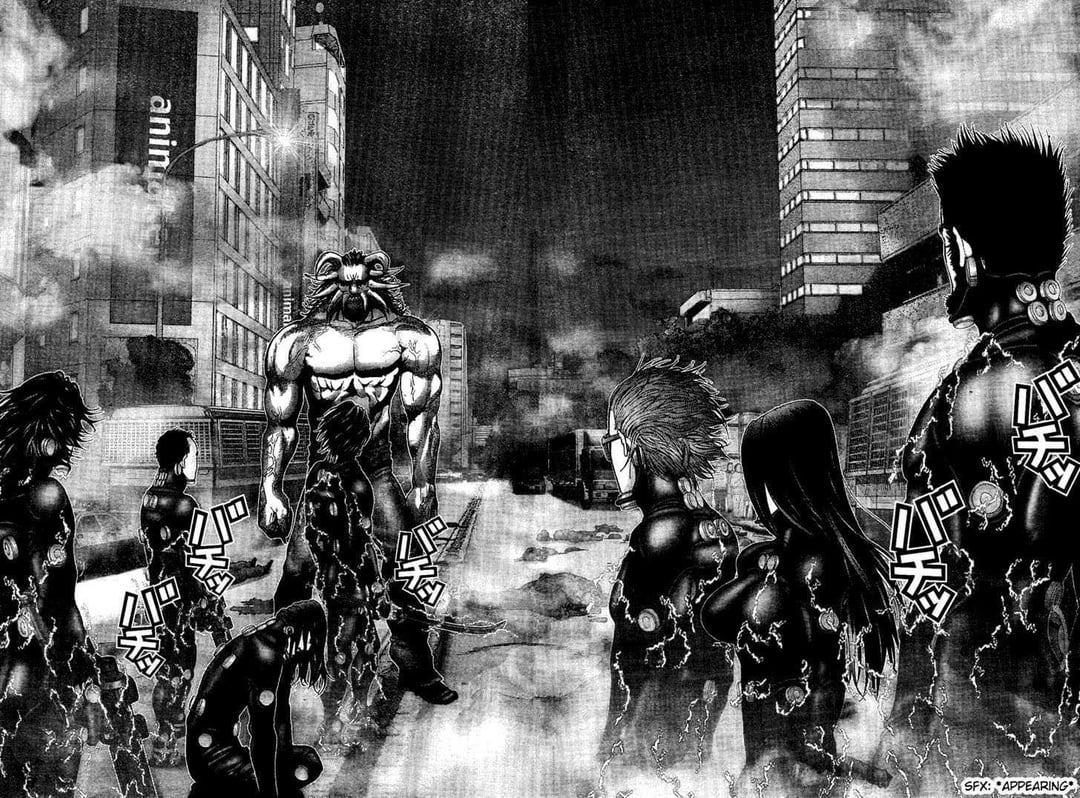
The protagonist, Kei Kurono, is thrust into a surreal game orchestrated by a mysterious black sphere called Gantz. This sphere controls its participants by setting them on violent missions with seemingly no escape. This cycle of control and spectacle closely mirrors the society Debord described, where participants are reduced to passive observers or pawns in a hypermediated world of entertainment, violence, and symbolism. Through Gantz, Oku stages a semiological guerilla war: each violent encounter between the “players” and alien enemies becomes a rupture in the spectacle itself. This acts as a symbolic defiance against the encroaching forces of meaninglessness, as characters fight not only for survival but also for autonomy over their identities in a hyper-technological age.
You could argue that Gantz stages a Situationist détournement, appropriating symbols of mass media (violence, sci-fi imagery, gaming culture) to question the very mechanisms that mediate contemporary experience. The game-like structure of Gantz can be seen as an allegory for the consumerist cycle where players are trapped in a perpetual quest for meaning within a system designed to distract and exploit.
- Echoes of Baudrillard: Simulacra and Simulation in Gantz
Jean Baudrillard’s theory of simulacra is highly relevant in analyzing Gantz. Baudrillard posits that in the postmodern world, reality is no longer a direct experience but a simulation—an endless cycle of images that refer to other images, losing their grounding in material reality.

In Gantz, the game itself is a hyperreal simulation. The characters are repeatedly resurrected and forced to engage in scenarios that blur the line between life and death, reality and illusion. The players’ bodies are digitized, reconstructed, and reprogrammed after each mission, calling into question their authenticity as living beings. Baudrillard’s concept of the “death of the real” is reflected in how the game distorts the characters’ sense of reality. Their lives are not their own; instead, they are rendered hyperreal by the technological omnipresence of Gantz, echoing Baudrillard’s third order of simulacra, where reality is subsumed entirely by signs.
Gantz functions as a mechanism of control, orchestrating life-or-death situations that feel real to the players but are inherently meaningless within the larger system of the game. Here, Oku’s creation echoes Baudrillard’s critique of how modern technological systems manufacture pseudo-events, where the violence and struggles within the game are mere fabrications—simulations designed to perpetuate the game’s internal logic. This positions Gantz as a reflection on the erosion of meaning in contemporary society, where individuals grapple with simulations of autonomy in environments controlled by technological systems.
- Posthuman Autonomy: The Techno-Biological Hybrid
Gantz can also be interpreted as a narrative of posthumanism. Posthumanism critiques the Enlightenment ideal of the autonomous, rational individual and instead emphasizes how humans are increasingly entangled with technology and networks of control. In Gantz, the characters’ bodies are reconstructed as technological artifacts after each mission. Their existence, to some extent, is shaped and controlled by an artificial system, reflecting the posthuman condition where the boundaries between human and machine blur.

Posthuman autonomy, in this sense, is defined by the paradox of control and dependency on technology. The players, while attempting to assert their will and survive the game, are fundamentally controlled by Gantz’s programming. They are resurrected and made to fight with advanced weaponry and technological suits, amplifying their abilities but simultaneously integrating them into a network of technological dominance. The players are more than human but less than free.
This dynamic echoes broader philosophical concerns about the future of human agency in an age dominated by artificial intelligence and biotechnological advancements. Hiroya Oku presents a world where humans, like the players in Gantz, are increasingly subject to systems of power and control that shape their reality and autonomy. This aligns with theories of posthumanism that consider the effects of technological evolution on human identity and agency, where traditional boundaries between human and machine dissolve into an interconnected, networked existence.
4.The Intersection of Control, Autonomy, and Spectacle
In Gantz, Hiroya Oku constructs a narrative that explores the tensions between autonomy and control in the context of technological over-determination, employing elements of Situationist semiology and Baudrillardian hyperreality to critique contemporary society. The series functions as both a reflection and subversion of the mediated, technologized world, using the structure of a violent game to expose the ways in which autonomy is undermined by omnipresent systems of control.

By engaging with Situationist ideas of semiological guerilla warfare, Gantz subverts the spectacle through violent ruptures in the game’s structure, while Baudrillard’s concept of simulation exposes the breakdown of reality within the hyperreal space of the game.
At the same time, the characters’ experiences of posthuman autonomy in the face of Gantz’s technological power offer a critical commentary on the diminishing role of human agency in the age of digital and biotechnological programming. Together, these elements situate Gantz as a complex reflection on the nature of autonomy, spectacle, and reality in the postmodern/posthuman world.
While Hiroya Oku’s other manga masterpieces, such as Inuyashiki and HEN, demonstrate his unique storytelling and thematic concerns, Gantz stands out as a more complex and rich work due to its intricate layering of philosophical, social, and technological issues. This depth is a result of several distinct factors:
5. Broader Philosophical Scope
Compared to Inuyashiki, which focuses on the moral struggle between good and evil in a technologically advanced society, Gantz delves deeper into a broader philosophical scope. It explores existential questions, not just about morality but also about reality, identity, and free will in a hypermediated world.
The characters in Gantz face repeated cycles of life and death, confronting the ultimate questions of existence: What does it mean to live authentically when existence is dictated by an artificial system? This existential exploration is less prominent in Oku’s other works, where the focus tends to remain more grounded in immediate, personal struggles.

In Inuyashiki, for example, the posthuman transformation of the characters serves primarily to explore the moral and ethical implications of power, but in Gantz, posthumanism is more deeply intertwined with questions of autonomy and technological control, raising far more abstract issues about what it means to be human in a world where the boundaries of reality are blurred.
6. Deeper Engagement with Postmodernism
Gantz engages with postmodern concepts more profoundly than Oku’s other works. While Inuyashiki deals with themes of alienation and the impact of technology on human life, Gantz goes further by incorporating Baudrillardian ideas of simulation, hyperreality, and the breakdown of the real.
The game-like structure of Gantz is not just a narrative device; it serves as a commentary on the postmodern condition, where reality is mediated by systems of signs and where individuals struggle to assert agency in a world dominated by spectacle and choose fragmentality in order to hidden by the subliminal light of Totalitarian Visibility and it’s unbearable transparency.
By comparison, Inuyashiki deals with the consequences of technological transformation more straightforwardly, focusing on how human nature responds to power and dehumanization. Gantz, however, transcends this by questioning the very nature of the reality in which these struggles occur, making it a more philosophically rich work in terms of its engagement with postmodern theory.
7. The Complexity of Social Critique
Oku’s work consistently critiques aspects of contemporary society, but Gantz offers a more multifaceted and layered critique compared to his other manga. In Inuyashiki, the social critique centers around themes of isolation, media culture, and the disconnect between generations. In Gantz, however, Oku weaves together a more complex tapestry of social critique, touching on consumerism, the dehumanizing effects of technological progress, and the commodification of violence as entertainment.

The game within Gantz becomes a metaphor for the alienation and absurdity of modern life, where individuals are trapped in systems of control that strip them of their humanity. This mirrors the real-world cycles of consumption, spectacle, and desensitization to violence in media. The sheer scale of this social critique makes Gantz a more ambitious and philosophically enriched work than Inuyashiki, where the critique remains more focused on personal and societal morality.
8.Greater Thematic Complexity
The thematic complexity of Gantz surpasses Oku’s other works due to its multifaceted exploration of violence, death, and survival. While violence is a recurring theme in much of Oku’s oeuvre, in Gantz, it takes on a symbolic, philosophical dimension.
The cyclical nature of death and resurrection in Gantz not only raises questions about the value of life but also critiques the spectator’s relationship to violence in a mediated world. The players are both victims and perpetrators of violence, complicating the traditional morality of the hero versus villain dichotomy seen in Inuyashiki.
In Inuyashiki, violence is more often depicted as a clear moral choice, with the protagonist using his power for good and the antagonist using his power for destruction. In Gantz, there is no such clear moral boundary.
Characters must navigate a morally ambiguous landscape where survival often necessitates brutality, reflecting the complexities of human nature in extreme circumstances. This moral ambiguity adds layers of psychological and ethical depth to Gantz, making it a richer work than Oku’s other more straightforward narratives.

9. Narrative and Structural Complexity
The structure of Gantz is far more complex than Oku’s other works, involving multiple timelines, arcs, and shifting perspectives. This complex structure allows Oku to explore a wide array of themes, characters, and philosophical issues simultaneously. The constantly shifting narrative—moving from the mundane realities of the characters’ lives to surreal, hyperviolent game scenarios—creates a sense of unpredictability that forces the reader to question the stability of the world they are engaging with.
By comparison, Inuyashiki follows a more linear and coherent narrative, focusing on the development of two main characters. While this allows for deep character exploration, it lacks the narrative intricacy of Gantz, where multiple characters undergo development in various intertwined plotlines, reflecting the fragmented, disorienting nature of postmodern existence. The episodic, game-like nature of Gantz also allows for more philosophical experimentation, as each new mission can be seen as a metaphor for a different existential dilemma or societal critique.
10. Technological Themes and the Posthuman Condition
In Gantz, Oku’s engagement with technology is both more complex and more profound than in his other works. Inuyashiki touches on posthumanism by exploring how human beings respond to their fusion with machines, but Gantz takes this a step further by presenting characters who are not just augmented by technology, but are literally recreated by it. The black sphere, Gantz, acts as both a godlike figure and a technological entity, highlighting the blurred boundaries between the biological and the artificial.
The characters in Gantz are continually resurrected, their bodies rebuilt with technological precision after each death. This constant reconstruction strips them of their traditional humanity, placing them in a posthuman space where their existence is governed by digital codes and algorithms.
This exploration of posthuman autonomy in Gantz is far more sophisticated than in Inuyashiki, where the characters’ posthuman transformation serves mainly to explore questions of power and responsibility rather than deeper existential and ontological concerns.
The Pinnacle of Oku’s Philosophical and Narrative Exploration
While Oku’s other works are notable for their exploration of power, technology, and societal critique, Gantz stands out as a richer and more complex creation due to its deeper philosophical engagement with postmodernism, existentialism, and posthumanism. Through its intricate narrative structure, morally ambiguous characters, and its exploration of the spectacle, violence, and control, Gantz elevates Oku’s work to a higher level of thematic and philosophical complexity. It is this intricate layering of ideas, combined with its narrative ambition, that makes Gantz not only a masterpiece within Oku’s oeuvre but also a significant work within the broader context of contemporary manga.
Moreover, we can certainly interpret Gantz as a Homo Ludens for the “revolted spirits” or “ghosts” of a posthuman, chaotic, transitional society. Johan Huizinga’s concept of Homo Ludens emphasizes that play is a fundamental part of human culture and that the structures of games reflect broader cultural, social, and philosophical ideas. In Gantz, the “game” orchestrated by the mysterious black sphere can be seen as a dark, twisted version of this playful nature—where the stakes of survival, identity, and autonomy reflect the chaotic nature of a posthuman society in transition. Let’s explore this in more detail:
11. Play as a Central Organizing Principle of Life and Death
In Huizinga’s Homo Ludens, play is not merely a frivolous activity; it is a critical mechanism through which culture, law, and society are structured. In Gantz, the entire world revolves around a game-like structure—where the characters are forced to play for their lives in a high-stakes, violent contest. This echoes Huizinga’s notion that play is not just a pastime but a serious activity that informs larger systems of meaning. However, Gantz is a dystopian inversion of Huizinga’s ideal of cultural play, where the game serves not to enhance culture but to reflect its breakdown.
The players in Gantz are compelled to participate in deadly missions, and the artificial construct of the “game” mirrors a society that has lost control over its structures of meaning, identity, and reality. In this sense, the characters are indeed like “revolted spirits”—trapped in a game that they didn’t choose, rebelling against the chaos that has overtaken their lives. The game becomes a metaphor for the posthuman condition, where individuals are no longer free but are trapped in a perpetual cycle of play, dictated by forces beyond their control.
12. The Revolted Spirits and Ghosts of a Posthuman Society
The “revolted spirits” or “ghosts” in Gantz—those who are resurrected by the Gantz sphere to participate in the game—can be interpreted as metaphors for the fragmented, dislocated identities that arise in a posthuman, technologically dominated society. Just as the players are repeatedly resurrected with their memories and bodies reconstructed, the posthuman individual exists in a state of liminality, between life and death, humanity and technology.

These characters are like ghosts of a past human society, embodying the anxiety and alienation of a world where human bodies and minds are digitized, controlled, and repurposed by external systems of power. Their struggle for autonomy in the face of a technologically controlled game echoes the broader societal transition from human-centered systems of meaning to a chaotic posthuman future.
The players’ rebellion against the Gantz system, whether through violent acts, attempts to break free, or efforts to regain control over their lives—mirrors the struggles of individuals in an anti-society of hyperreal, technologically mediated systems.
13. Posthuman Transition and Chaotic Play
Gantz can be seen as a representation of a posthuman society in chaotic transition, where traditional structures of meaning (such as life, death, morality, and identity) have broken down, and individuals must navigate this chaos through play. Huizinga’s idea that culture is structured around rules and boundaries of play is reflected in Gantz, but these rules are constantly shifting and subject to the whims of an opaque system (the Gantz sphere).
This creates a chaotic environment where the players’ actions are seemingly meaningless, and the consequences of their choices are arbitrary, reflecting the disintegration of coherent systems of meaning in a posthuman, technologically dominated world.
In this transitional society, the chaotic nature of the game reflects the broader dissolution of human centric agency in the face of overwhelming technological implosions.
The characters are trapped in a game that resembles the unpredictable, uncontrollable aspects of life in a world where technology has become the primary reality. This transition, from human to posthuman, is reflected in the structure of the game itself—constantly evolving, uncertain, and disconnected from traditional human values.

14.The Ludic Nature of Survival
In Gantz, the act of survival becomes a game, where the players’ bodies are treated as disposable and their lives as mere points in a larger system of competition. This reflects Huizinga’s idea that even in the most serious contexts—such as war, politics, or survival—there is a ludic element at play.
In Gantz, survival is literalized as a game, where the rules are opaque, and the outcome is uncertain. The players must navigate not only physical challenges but also psychological ones, as they grapple with the loss of their humanity and their status as mere pawns in a larger system.
This makes the concept of play in Gantz much more fraught and darker than in Huizinga’s Homo Ludens. Here, play does not serve as a positive cultural force but as a mechanism of control and alienation. The ludic nature of existence in Gantz reflects the experience of individuals in a posthuman society, where survival often feels like a game played according to rules that are difficult to understand or manipulate.
15. Autonomy and Revolt in the Ludic System
Finally, the characters in Gantz represent the “revolted spirits” of Huizinga’s Homo Ludens, rebelling against the very structure of the game. They seek autonomy and meaning in a world where these things are increasingly mediated by technology.
The rebellion of these “spirits” or “ghosts” represents the desire to break free from systems of control, to assert individuality and autonomy even in a world where the new identity is absolutely disconnected from human values and constructed by vitalities, energies and intelligences of unpredictable intentions.
As they fight against the seemingly omnipotent Gantz sphere, they struggle not only for survival but for meaning in a world where traditional human experiences—like death, memory, and morality—are no longer stable.
This revolt against the game mirrors a broader contradiction , a revolt against technological domination and the erosion of human autonomy in the posthuman era which at the same time expresses an update of a abbysal acceleration of new contingencies and forms of appearance and disappearance.
Gantz as Homo Ludens of the Posthuman Condition
In conclusion, Gantz can be interpreted as a Homo Ludens for the “revolted spirits” of a posthuman, chaotic society. The characters are blossomed in a game that reflects the chaotic, transitional nature of their world, where technological control and posthuman identity complicate traditional human values.
Their rebellion against the game represents the broader blind need to pursuit autonomy, meaning, and identity in an increasingly fragmented world not as an ethical idea but as an intriguing motivation for the placement of Fragile beings in a much more dynamic environments.
In this sense, Gantz takes Huizinga’s idea of Homo Ludens—the notion that play is central to culture—and twists it into a dark allegory for the posthuman condition, where play becomes a mechanism of control, sabotage, abstract chaotic situation and morphological category of a new type of existence.The players are ghosts, not just of the game, but of a past human society, embodying the alien contingency and confusion of a world in transition from human to posthuman.
to be continued..


